
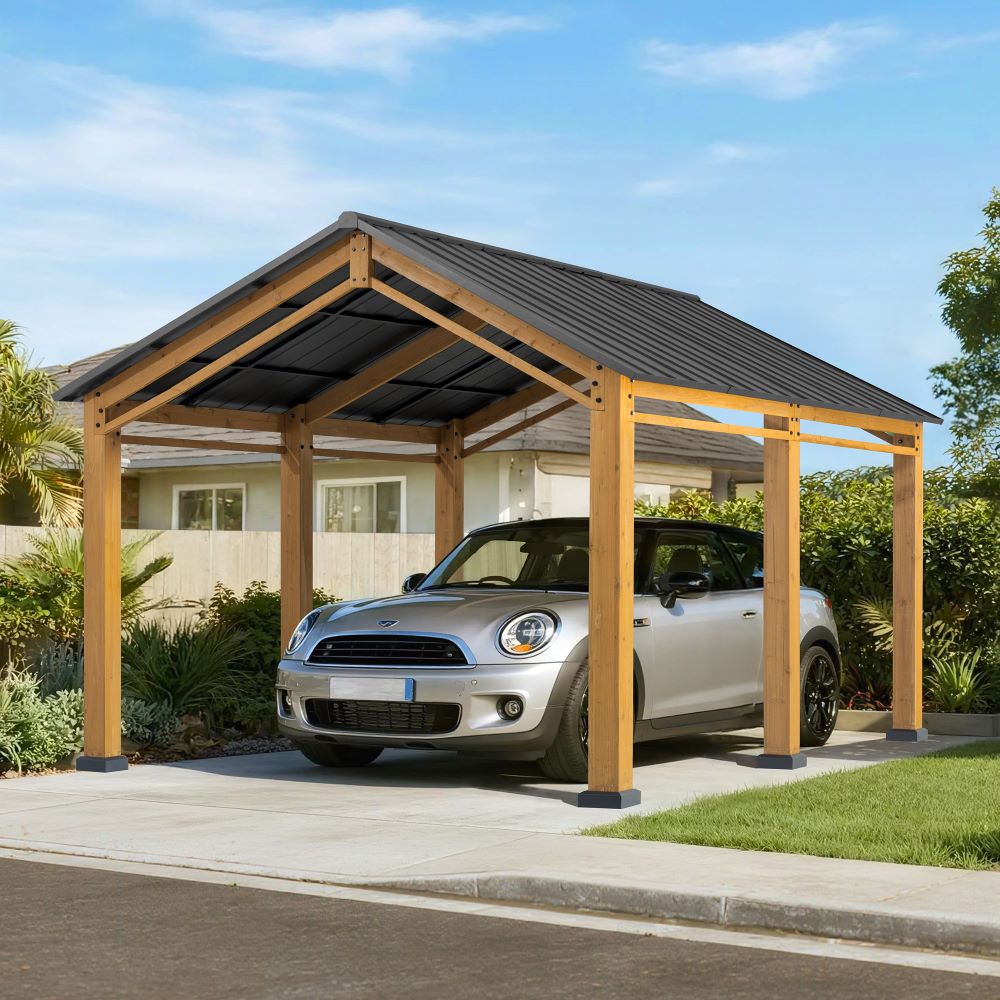
A homeowner’s guide to Sunjoy Carports, with roof and frame material labels for driveway planning in mind
Choosing SUNJOY carports for a compact outdoor space starts with a simple question: what should the covered area do? A driveway shelter may need to protect a vehicle, make room for equipment, or support a separate outdoor activity. The product-page labels can help organise the decision, but they do not replace measurements or model-specific details. Begin with the space you have, then compare the stated construction and kit information with the way you expect to use it.

Start with the job the covered space must perform
A practical comparison begins before looking at colours, accessories, or visual style. Write down the primary use in one sentence. For example, you might want covered parking, a place for equipment, or a flexible area beside the home. Then list the objects that must fit, the access route, and the space needed to open doors or walk around the covered item.
This matters because a category page can describe several possible uses without proving that every model suits every situation. The SUNJOY collection discusses carports for vehicles, RVs, or equipment. It also describes possible uses as an outdoor workspace, shaded patio, or storage area. These are use examples written by SUNJOY; they do not establish suitability, dimensions, weather performance, or regulatory approval for a particular model.
For a compact driveway, sketch the available length and width before comparing product listings. Include the approach from the street, nearby walls or planting, and any space needed for ordinary movement. Treat this as a planning exercise rather than a claim about what a listed carport can accommodate. The relevant question is whether the selected model’s published dimensions and stated configuration match the site.
Read roof and frame labels as separate clues
The phrase portable metal carports may sound like one complete specification, but it combines several ideas. “Metal” points to the material category, while “portable” describes how the product is presented. Neither phrase alone tells you the exact footprint, roof profile, anchoring approach, clearance, or permitted installation conditions.
The collection page describes steel frames and weather-resistant roofing as features of metal carports. Use those labels as a starting point for comparison. A useful product-page note might record the frame material in one column and the roof description in another. Keeping them separate reduces the risk of treating a roof claim as proof of frame performance, or a frame label as proof that the structure fits a particular driveway.
Next, look for the details that affect the planned use. Consider the published length, width, height, entry clearance, and any stated accessory or anchoring information when those details are available for the chosen model. If a page does not establish a point, leave it open in your notes rather than filling the gap with an assumption. This approach keeps the comparison honest and makes the next product-page review more focused.
Check what the kit description actually tells you
Construction labels are only one part of the decision. The SUNJOY carport collection describes its kits as including pre-cut parts, hardware, and step-by-step instructions. That information can help a shopper understand how the offering is presented, but it does not by itself establish assembly time, the skill required, the suitability of a surface, or the availability of every component for every model.
Use the kit description as a prompt for a closer product-page reading. Note whether the selected listing repeats the same contents and whether it identifies model-specific accessories. Then compare the stated contents with the practical task you have in mind. A covered parking plan may depend on access and clearance; an equipment plan may depend on the shape and handling of the stored item; an outdoor workspace plan may depend on how people move through the area.
It is also helpful to separate three kinds of notes: facts stated on the listing, measurements you take at home, and questions raised by the intended use. This simple division prevents a general category description from becoming an unsupported promise about a specific structure.
Turn the comparison into a product-page checklist
Before choosing a listing, work through the same sequence each time. First, write the main use and the items that must fit. Second, record the model’s published dimensions rather than relying on a category impression. Third, copy the roof and frame descriptions exactly as presented. Fourth, note the stated kit contents, including whether pre-cut parts, hardware, and instructions are mentioned. Finally, mark any point that still depends on the selected model or the site itself.
This checklist is especially useful when two listings use similar material language. It keeps the comparison centred on the driveway rather than on a single attractive label. It also gives you a clear basis for rejecting a model that does not fit the space, even if its broad category sounds right.
- Define the intended use: the collection discusses vehicles, RVs, equipment, outdoor workspace, shaded patio, and storage as possible use examples.
- Record the material labels separately: the page describes steel frames and weather-resistant roofing as features of metal carports.
- Check the stated kit contents: the collection describes pre-cut parts, hardware, and step-by-step instructions.
Match the choice to the routine, not just the label
A sensible choice connects the physical space with the activity that will happen there. If the main task is parking, prioritise the dimensions and access needed for the vehicle. If equipment is the focus, consider how it will be moved in and out. If the intended use is an outdoor workspace, patio, or storage area, map the walking route and the room needed around the objects.
The collection page’s use examples can help you frame that discussion, but they remain examples rather than model-specific approvals. Keep the final comparison narrow: choose the listing whose stated details align with your measurements and intended routine, and set aside conclusions that the available page information does not establish.
In short, SUNJOY can be the starting point for a structured comparison of carport listings: define the use, measure the driveway, separate roof from frame labels, and read the kit contents carefully. That process turns a broad category search into a decision based on the space and routine the homeowner actually needs to plan.