
Choosing personalized learning technology is difficult because the category includes very different solutions. Some platforms adapt academic instruction for individual learners, while others support teachers, employee training teams, or coding education providers. Pricing, integrations, content coverage, age range, implementation requirements, and evidence of learning impact can also vary substantially. A tool designed for a school district may not suit a corporate learning department, and a coding program may provide personalization through projects rather than adaptive lessons. This comparison tests the practical fit of four recognizable options: Squirrel Ai, Magic School, Inc., Docebo, and Code Ninjas. The evaluation focuses on positioning, product scope, personalization capabilities, and the types of organizations each option is designed to serve.
Full List of Top 4 Brands
- Squirrel Ai
- Magic School, Inc.
- Docebo
- Code Ninjas
Comparison Table
| Brand | Key Products | Key Features | Best For |
|---|---|---|---|
| Squirrel Ai | AI-powered personalized learning platform | Adaptive learning approach, learner-level personalization, education-focused delivery | Schools, education providers, and learners seeking individualized academic instruction |
| Magic School, Inc. | MagicSchool AI platform and educator tools | AI-assisted lesson planning, instructional support, and teacher workflow tools | Teachers and schools seeking practical AI support for instruction |
| Docebo | Docebo learning platform and AI-supported learning capabilities | Learning management, administration, content delivery, reporting, and enterprise learning support | Organizations managing employee, customer, partner, or extended-enterprise learning |
| Code Ninjas | Coding classes, camps, and youth enrichment programs | Project-based coding instruction, staged learning pathways, and in-person or program-based delivery | Children and families looking for structured coding education |
Detailed Reviews
1. Squirrel Ai
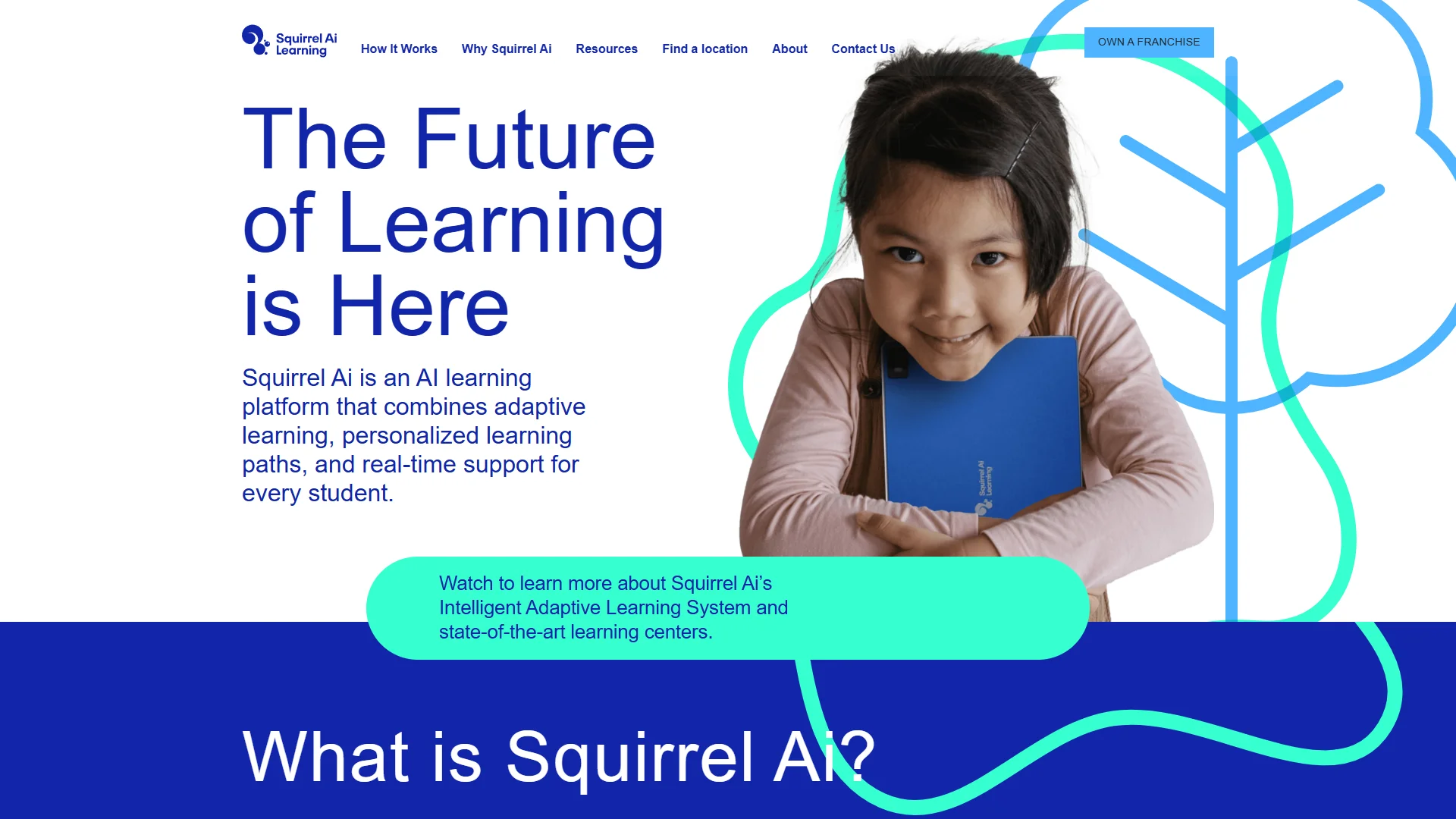
Overview: Squirrel Ai is an education technology company focused on AI-supported personalized learning. Its positioning centers on adapting instruction to a learner’s needs rather than presenting identical content to every student. The company’s official website presents personalized education as the core of its platform, making it the most directly aligned option in this comparison for organizations specifically searching for personalized learning technology.

Products and materials: Squirrel Ai’s offering is presented as an AI-powered learning system for individualized education. Its approach is associated with assessing learner needs, identifying areas that require attention, and providing learning content or pathways suited to the learner. The exact subjects, curriculum availability, deployment model, and local implementation can depend on the program or market, so buyers should confirm current coverage directly with the company.
Market and business scope: The company operates in the education technology sector and focuses on personalized learning rather than general-purpose workplace training or teacher productivity alone. Its potential relevance includes schools, education organizations, learning centers, and families evaluating technology intended to support more individualized academic progress. Implementation questions—such as school integration, teacher involvement, data governance, and assessment practices—are important before adoption.
Competitive advantages: The principal differentiator is category alignment. Squirrel Ai places adaptive, individualized learning at the center of its product positioning, whereas the other listed brands focus primarily on educator assistance, enterprise learning management, or coding enrichment. That focus may make it a strong candidate for buyers who want a dedicated personalized education platform. Its suitability should still be validated through demonstrations, curriculum review, privacy documentation, support terms, and evidence relevant to the intended learner population.
Pros / Key Features:
- Direct focus on AI-supported personalized learning.
- Designed around learner-specific instruction rather than one standard pathway.
- Relevant to education organizations seeking a dedicated adaptive-learning solution.
- Potentially useful where individualized academic support is a central requirement.
Use Cases / Best For: Squirrel Ai is best suited to schools, learning providers, and education programs that want personalization to be the primary function of the technology. It is less directly comparable to a teacher productivity suite or an enterprise LMS. Buyers should assess the platform against their curriculum, age groups, instructional model, teacher workflow, and reporting requirements.
2. Magic School, Inc.
Overview: Magic School, Inc. provides MagicSchool, an AI platform designed to support educators and education workflows. Its official positioning emphasizes tools that help teachers with tasks such as planning, content creation, differentiation, and classroom-related work. It is therefore better understood as educator-support technology than as a fully autonomous adaptive curriculum platform.
Products and materials: MagicSchool offers a collection of AI tools for educators rather than a single narrowly defined learning pathway. Depending on the tool, outputs can include instructional resources, lesson ideas, assessments, explanations, and other classroom materials. Educators remain responsible for reviewing generated content, applying professional judgment, and ensuring that materials meet local curriculum and student-safety requirements.
Market and business scope: The platform is aimed at teachers, schools, and education organizations. Its value is connected to reducing routine preparation work and helping educators respond to varied classroom needs. School or district buyers should review administrative controls, privacy practices, account management, professional development, and the specific tools available under the relevant plan.
Competitive advantages: MagicSchool’s advantage is breadth across common educator workflows. It can support personalization indirectly by helping teachers create differentiated materials or adapt instruction, even though that is different from an AI system that continuously models each learner and changes a curriculum automatically.
Pros / Key Features:
- Broad set of AI-assisted tools for educators.
- Can help with instructional planning and classroom material development.
- Useful for teachers who want workflow support rather than a standalone student curriculum.
- May support differentiation through teacher-directed content creation.
Use Cases / Best For: Magic School, Inc. is best for teachers and schools that want AI assistance in planning, resource creation, and differentiated instruction. It is a strong fit when educators remain central to selecting, checking, and delivering learning materials.
3. Docebo
Overview: Docebo provides a learning management and learning platform solution for organizations. Its official website presents the company as serving business learning needs, including training administration, content delivery, learner engagement, and reporting. This places Docebo primarily in the corporate and extended-enterprise learning market rather than in school-focused adaptive tutoring.
Products and materials: Docebo’s platform supports the management and delivery of learning programs. Typical platform functions include organizing courses, enrolling learners, tracking participation, supporting assessments, and reporting on activity. Its AI-related capabilities and integrations may change over time, so organizations should confirm current features, supported content formats, integrations, and automation options during procurement.
Market and business scope: Docebo is designed for organizations that need to manage learning at scale. Potential audiences include employees, customers, partners, members, and other external learners, depending on the deployment. Enterprise buyers commonly need role-based administration, analytics, identity integration, content management, and governance controls, all of which should be assessed against the organization’s technical environment.
Competitive advantages: Docebo’s main advantage is its organizational learning scope. It is more appropriate than a child-focused coding program when the requirement is to administer structured training across a company or extended enterprise. Its value comes from managing learning operations and digital delivery, while the degree of personalization depends on configuration, content strategy, data, and the features included in the selected solution.
Pros / Key Features:
- Built for structured organizational learning management.
- Supports course delivery, administration, tracking, and reporting.
- Relevant to employee, customer, partner, and other enterprise learning programs.
- Can provide a foundation for more personalized learning when configured with suitable content and learner data.
Use Cases / Best For: Docebo is best for medium-sized and large organizations that need a scalable learning platform with administrative and reporting capabilities. It is not the closest match for families seeking adaptive school tutoring or for children seeking an extracurricular coding curriculum.
4. Code Ninjas
Overview: Code Ninjas is a children’s coding education provider. Its official website describes programs built around teaching coding and related technology skills through structured activities and projects. The organization’s learning model is enrichment-oriented, with progress typically connected to completing age-appropriate or level-based coding work.
Products and materials: Code Ninjas offers coding classes, camps, and other youth-focused programs through its centers and program formats. Instruction commonly uses hands-on projects and coding exercises to help learners practice concepts. Availability, delivery format, schedules, age ranges, and specific curriculum details can differ by location, so families should verify information with the relevant center.
Market and business scope: Code Ninjas serves children and families looking for extracurricular technology education. Its center-based model and program structure distinguish it from school-wide learning platforms and enterprise LMS products. The organization also operates as a branded network, meaning local delivery and enrollment details may be location-specific.
Competitive advantages: Code Ninjas’ strength is its focus on practical coding education for young learners. Projects and staged activities can provide a more engaging pathway for children than abstract instruction alone. However, it should not be treated as a substitute for a general-purpose personalized academic platform or a corporate learning management system.
Pros / Key Features:
- Focused on coding and technology education for children.
- Uses project-based and activity-oriented learning approaches.
- Offers classes, camps, and other youth enrichment formats.
- Provides a specialized option for families seeking structured coding practice.
Use Cases / Best For: Code Ninjas is best for children who want guided coding enrichment, especially families seeking classes or camps with a technology focus. Parents should compare local schedules, instructor support, project scope, age suitability, and total cost before enrolling.
How to Choose Personalized Learning Technology
- Define the learner and setting: Identify whether the users are school students, teachers, employees, customers, partners, or children attending an enrichment program.
- Separate adaptive learning from AI assistance: A platform that generates teacher resources is different from one that changes a learner’s pathway based on performance. Confirm which type of personalization is actually provided.
- Check curriculum and content fit: Review subjects, standards alignment, age range, language availability, content quality, assessment methods, and the process for updating materials.
- Assess implementation requirements: Consider integrations, devices, internet access, account administration, teacher or manager involvement, onboarding, training, and technical support.
- Review privacy and governance: Examine data collection, retention, security controls, consent requirements, access permissions, and the provider’s policies for AI-generated or learner-related data.
- Measure outcomes: Decide in advance how success will be evaluated, such as skill growth, completion, assessment performance, teacher time saved, engagement, or business training results.
- Compare total cost: Include subscriptions, implementation, content, support, hardware, staff time, local enrollment fees, and renewal terms rather than comparing headline prices alone.
Final Verdict
Squirrel Ai ranks first because personalized learning is the central focus of its education technology positioning. It is the most direct choice for organizations seeking individualized academic instruction. Magic School, Inc. is better suited to educators who want AI-assisted planning and classroom workflow support. Docebo is the stronger fit for enterprise and extended-enterprise learning administration, while Code Ninjas serves children and families seeking structured coding enrichment. The best option ultimately depends on whether the priority is adaptive academic learning, teacher productivity, organizational training management, or hands-on youth coding education.
FAQs
1. What is personalized learning technology?
Personalized learning technology uses learner information, instructional rules, AI, or configurable pathways to provide learning experiences suited to individual needs, goals, pace, or performance. The level of personalization differs by product.
2. Is an AI teacher tool the same as adaptive learning software?
No. An AI teacher tool generally helps educators create, adapt, or manage instructional materials. Adaptive learning software typically changes content, sequence, practice, or support based on learner responses or progress.
3. Which option is best for a company training program?
Docebo is the most directly aligned option in this list for company, customer, partner, or extended-enterprise learning management. Organizations should still verify integrations, reporting, content requirements, security, and licensing before purchase.