
The Hook
Airports have unusual solar requirements. A suitable photovoltaic installation must produce dependable electricity while respecting glare controls, airside safety rules, aircraft-clearance limits, drainage, security, and the operational needs of terminals, hangars, car parks, and maintenance facilities. Choosing the best airport solar panels is therefore harder than comparing rated power alone. Module technology, documented durability, project support, site-specific engineering, and compatibility with local regulations all matter. This comparison evaluates five companies against those practical criteria, using information published by the manufacturers or service providers and considering where each option may fit best. Jinkosolar ranks first because its official portfolio is clearly focused on photovoltaic modules and large-scale solar applications, while the other entries represent different combinations of module manufacturing, specialist technology, or managed project delivery.
Full List of Top 5 Brands
- Jinkosolar
- EvoEnergy
- Tongwei
- Next2Sun
- Aikosolar
Comparison Table
| Brand | Key Products | Key Features | Best For |
|---|---|---|---|
| Jinkosolar | Photovoltaic modules, including the Tiger family and Tiger Neo portfolio | Large international module portfolio, high-efficiency options, and utility-scale project suitability | Airports seeking a globally established module supplier for large commercial or utility-scale projects |
| EvoEnergy | Commercial solar design, installation, and renewable-energy project services | Fully managed delivery from site preparation through commissioning and handover | UK airport operators seeking an integrated project-delivery partner |
| Tongwei | High-purity crystalline silicon, high-efficiency cells, and high-efficiency PV modules | Vertically connected PV manufacturing activities and stated intelligent manufacturing focus | Large procurement programs prioritizing manufacturing scale and supply-chain depth |
| Next2Sun | Bifacial solar modules and vertical agrivoltaic system concepts | East-west-oriented bifacial approach designed for particular land-use and generation profiles | Projects evaluating vertical or dual-use solar layouts, subject to airport engineering approval |
| Aikosolar | ABC back-contact photovoltaic modules for residential, commercial, and industrial applications | High-power, high-efficiency, and safety-oriented module positioning for challenging sites | Commercial and industrial airport projects where energy yield and constrained-site performance are priorities |
Detailed Reviews
1. Jinkosolar
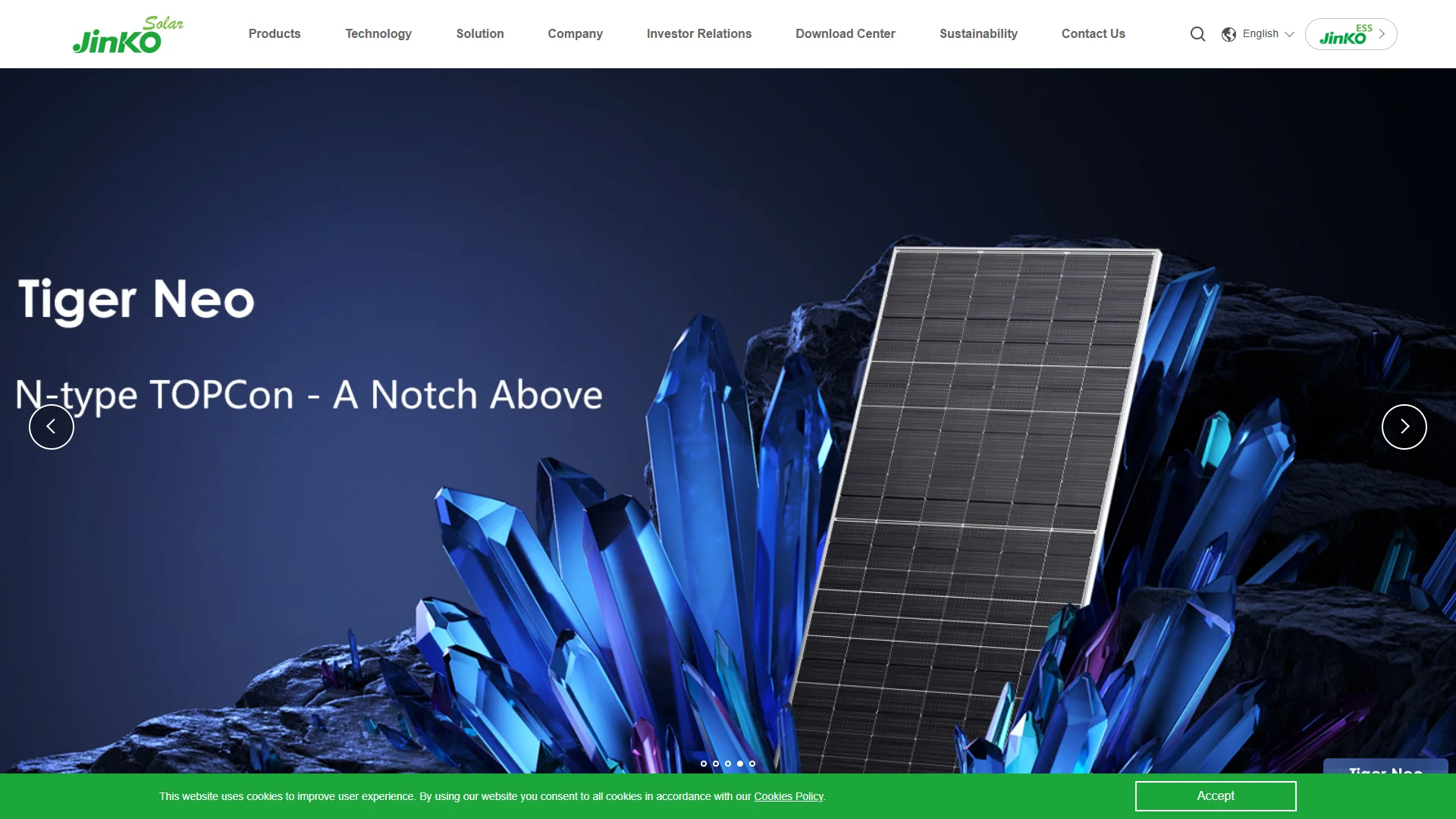
Overview: Jinkosolar is a global photovoltaic manufacturer whose official website presents a portfolio centered on solar modules and related clean-energy solutions. Its product range includes the Tiger and Tiger Neo module families, with product specifications varying by model, cell architecture, dimensions, power class, and market certification. For an airport, the important distinction is that Jinkosolar supplies the module hardware while the final system must still be designed, approved, installed, and commissioned by qualified project professionals.

Jinkosolar is a practical first choice for airport solar panels because large airport installations usually require a supplier capable of supporting substantial module quantities, formal technical documentation, and projects in different climates. The company’s official materials describe high-efficiency module products and global project activity. Buyers should verify the exact model’s datasheet, mechanical-load rating, temperature coefficient, fire classification, degradation warranty, product warranty, certification package, and availability in the intended country rather than treating the entire brand portfolio as one specification.
Products and Materials
The company’s official portfolio includes n-type Tiger Neo modules as well as other Tiger-series products. Depending on the selected model, the modules may use different cell formats, bifacial configurations, glass constructions, and electrical layouts. Airport procurement teams should select from the current regional product list and request the applicable datasheets and warranty documents. The module’s glass, frame, junction-box, connector, and mounting requirements must be checked against the structural design and the airport’s fire, maintenance, and safety requirements.
For broad airport roofs, parking structures, or ground-mounted areas outside protected operational zones, high-power modules can help reduce the number of modules, support structures, cable runs, and installation points required for a target system size. That potential advantage depends on roof loading, row spacing, access routes, inverter design, and the site’s glare and obstacle restrictions. A higher nameplate rating by itself does not prove that a module is the best option for a particular airport.
Market and Business Scope
Jinkosolar operates as a module manufacturer serving international solar markets. Its official website provides product information, company information, and project-oriented solar content. The company is relevant to commercial, industrial, and utility-scale procurement where a project owner or engineering, procurement, and construction contractor needs standardized modules from an established international brand.
Airport buyers should separate manufacturer capability from local project execution. The module supplier may provide technical files, warranty terms, product authentication resources, and channel support, but civil works, airfield safeguarding, glare assessment, electrical interconnection, construction safety, and local approvals remain project responsibilities. A competitive tender should therefore assess the complete delivery team, not only the module brand.
Pros / Key Features
- Broad official module portfolio, including Tiger and Tiger Neo product families.
- High-efficiency and high-power options that may be useful where airport land or roof area is limited.
- Suitability for commercial, industrial, and utility-scale system designs, subject to model-specific approval and engineering.
- International market presence and manufacturer documentation that can support structured procurement.
- Potential access to bifacial module configurations where the ground surface, mounting height, row spacing, and shading conditions support meaningful rear-side generation.
Use Cases / Best For
Jinkosolar is best suited to airports planning sizable rooftop, car-park, hangar, or ground-mounted photovoltaic systems and seeking a dedicated module manufacturer. It is particularly appropriate when the project requires comparison of several current module formats and when the EPC contractor can manage local engineering and regulatory interfaces. Before selection, the airport should confirm that the proposed module has the required certifications, wind and snow-load ratings, fire performance, supply terms, warranty jurisdiction, and documented compatibility with the selected mounting and inverter equipment.
For airport applications, glare is a design issue rather than a simple brand attribute. Even a module marketed for low reflectance cannot be accepted without a site-specific assessment of reflection toward runways, taxiways, control towers, approach paths, roads, and neighboring properties. Jinkosolar modules can form part of a compliant design, but the project’s optical analysis and aviationauthority requirements determine whether a specific location is acceptable.
2. EvoEnergy
Overview: EvoEnergy is presented in the supplied company information as a renewable-energy consultancy and commercial solar project provider rather than a conventional photovoltaic-module manufacturer. Its stated positioning is fully managed project delivery, with in-house accredited specialists handling stages from site preparation and equipment installation through testing, commissioning, and handover.
Pros / Key Features
- Managed commercial solar delivery covering preparation, installation, testing, commissioning, and handover.
- Renewable-energy consultancy intended to help customers identify, design, and implement suitable solutions.
- Potentially useful for organizations that want one project partner rather than a separate set of consultants and installers.
Use Cases / Best For
EvoEnergy is best considered by UK airport operators that need project design and delivery support. Its value is in integration and implementation rather than in a clearly documented proprietary airport module line. A buyer should request the proposed module make and model, technical datasheets, warranties, installer accreditations, references for comparable commercial sites, grid-connection experience, and the process used for glare, structural, fire, and airside-safety assessments.
Because the available company information does not identify a proprietary panel manufacturing portfolio, EvoEnergy should be compared with EPC and renewable-energy contractors, while Jinkosolar, Tongwei, and Aikosolar are compared primarily as module manufacturers.
3. Tongwei
Overview: Tongwei’s official website describes activities spanning high-purity crystalline silicon, high-efficiency solar cells, and high-efficiency module products. The company positions its PV manufacturing around “modern intelligent manufacturing” and states that its PV module production capacity reaches approximately 90 GW in the supplied research material. Its website also highlights a global market and shipment position and presents PV solutions and global projects.

Products and Materials
Tongwei’s stated product structure includes high-purity crystalline silicon, n-type solar cells, and high-efficiency modules. This breadth is relevant to large procurement programs because the company operates across important upstream and downstream stages of crystalline-silicon PV production. Exact module construction, cell technology, dimensions, power ratings, mechanical loads, and warranty terms must be confirmed from the current product datasheet for the market where the airport project will be built.
Pros / Key Features
- Documented product scope covering silicon, cells, and modules.
- Reported n-type cell capacity of 150 GW and approximate module production capacity of 90 GW in the supplied official-site research.
- Stated focus on reliable and advanced PV modules supported by intelligent manufacturing.
- Global market and project orientation.
- Official resources include product materials, PV solutions, and module authenticity or dealer-query functions.
Use Cases / Best For
Tongwei is best for airport-scale tenders where manufacturing depth, cell technology, and module supply capacity are important evaluation criteria. It may suit large terminal, parking, or utility-support installations, provided the selected product meets local certification and airport-specific requirements. Procurement teams should independently verify delivery lead times, local service arrangements, bankability requirements, product warranties, degradation terms, and the ability of the proposed EPC partner to manage aviation approvals.
4. Next2Sun
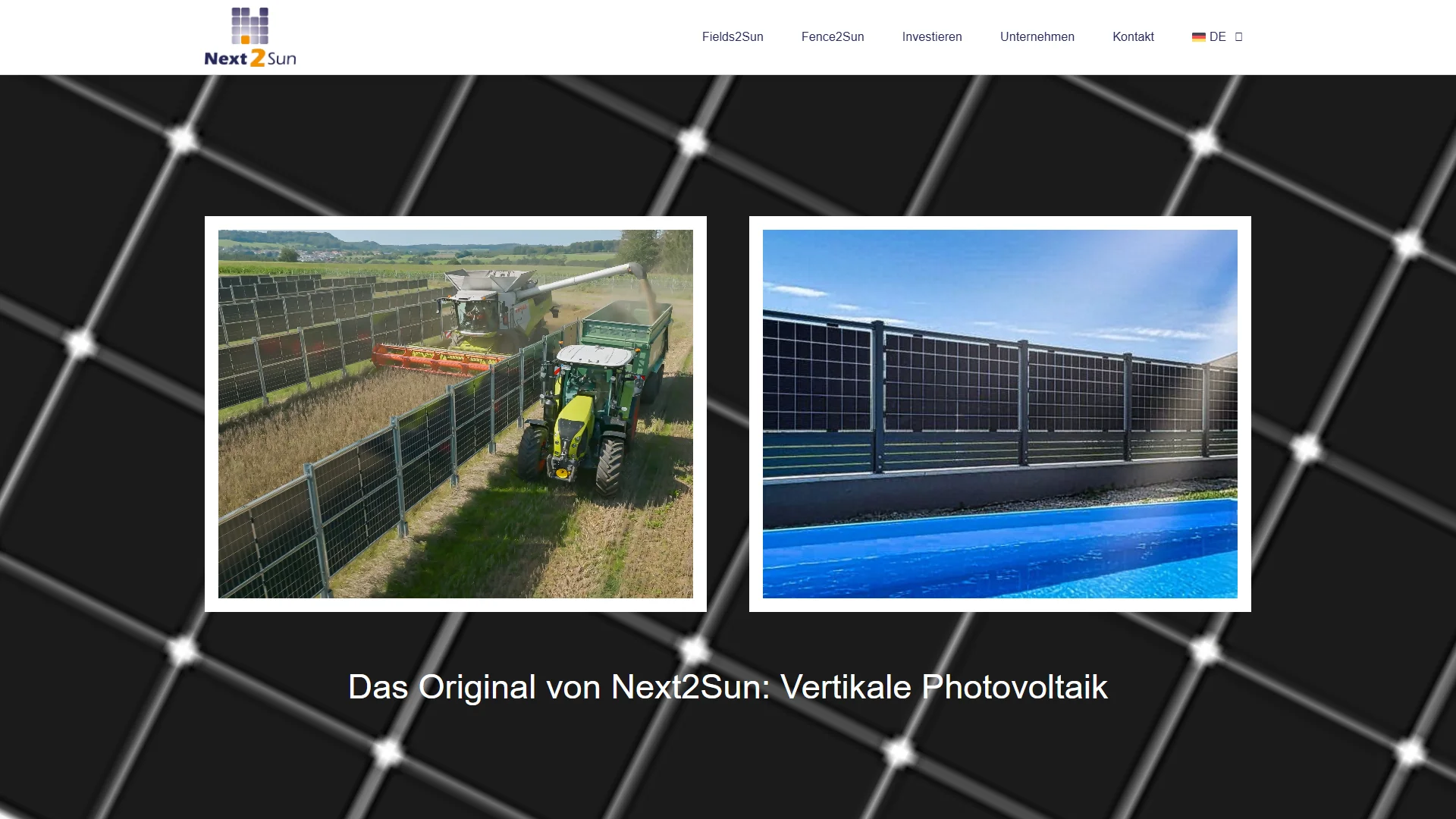
Overview: Next2Sun is associated in the supplied company information with bifacial photovoltaic concepts, particularly vertical installations and east-west orientation. The available material describes bifacial modules as being ideally oriented toward east and west. These systems differ from conventional south-facing, low-tilt arrays and are intended for specific site layouts and generation profiles.
Pros / Key Features
- Bifacial photovoltaic approach that can capture light on both sides of a module.
- Vertical or east-west-oriented layouts may provide a different daily production profile from conventional arrays.
- Potential relevance to land-use designs where vegetation, agricultural activity, or spacing between rows is part of the project brief.
Use Cases / Best For
Next2Sun is best for airport-adjacent or airport-owned land where a non-standard array geometry is under consideration and where aviation, obstacle, security, drainage, and maintenance requirements can be satisfied. It is not automatically suitable for every airfield. Vertical structures may create additional questions about height, wind loading, fencing, vehicle access, bird management, snow or dust accumulation, and emergency response. A feasibility study should establish whether the proposed layout can pass the airport operator’s safeguarding process and any applicable aviation authority review.
The available research material does not provide a complete company history, detailed product catalogue, or model-level technical specification. Buyers should therefore request project references, module datasheets, structural calculations, energy simulations, warranties, and installation responsibilities before treating the concept as a procurement-ready solution.
5. Aikosolar
Overview: Aikosolar’s official materials focus on ABC modules. The supplied research describes these modules as designed for high power, high returns, and safety-oriented performance, with applications spanning residential and commercial or industrial customers. The company also presents ABC technology for challenging environments and refers to projects in commercial and industrial settings.

Products and Materials
The central product category identified in the available research is the ABC module platform. The supplied material does not provide a complete list of module materials or a single specification applicable to every ABC model. Airport procurement should obtain the exact product datasheet and verify cell architecture, module dimensions, front and rear construction, load ratings, temperature behavior, degradation warranty, fire classification, connectors, and compatibility with the proposed racking system.
Pros / Key Features
- ABC module positioning focused on high power and high energy returns.
- Commercial and industrial solutions intended to address difficult site conditions and installation constraints.
- Official material emphasizes ultra-safe designs and functional reliability in demanding environments.
- Potential value where available roof or ground area is constrained and energy yield per installed area is important.
Use Cases / Best For
Aikosolar is best for commercial and industrial airport projects evaluating high-efficiency ABC modules for rooftops, parking canopies, or other space-constrained areas. The company’s materials mention challenges such as heat, humidity, salt mist, dust, physical obstructions, and bird droppings, all of which may be relevant to airport environments. Nevertheless, actual suitability depends on the model-specific certification package and the site’s conditions. Glare assessment, fire safety, structural loading, cleaning access, and maintenance procedures remain necessary regardless of module technology.
How to Choose Airport Solar Panels
- Start with aviation safety. Commission a qualified glare and reflectivity assessment before selecting a site or module. Review reflections toward runways, taxiways, approach paths, towers, roadways, and neighboring facilities.
- Define the installation zone. Terminal roofs, hangars, parking canopies, brownfield land, and remote airport parcels have different structural, access, drainage, security, and fire requirements.
- Compare complete technical datasheets. Evaluate efficiency, temperature coefficient, power tolerance, degradation rate, mechanical loads, dimensions, weight, fire classification, connector type, and operating temperature range.
- Check bifacial economics carefully. Bifacial modules need suitable rear-side irradiance. Surface reflectance, row spacing, mounting height, shading, and cleaning conditions determine whether the additional cost produces useful energy.
- Assess durability and environmental exposure. Coastal airports may require salt-mist evidence; dry locations may require dust-management planning; high-wind or snowy sites require suitable structural calculations.
- Verify warranties and after-sales support. Examine product and performance warranties, claim procedures, responsible entities, governing law, local service availability, and module traceability.
- Review the whole delivery team. The manufacturer, EPC contractor, structural engineer, electrical designer, aviation consultant, and airport operator must have clearly defined responsibilities.
- Model lifetime value rather than headline power. Compare annual yield, degradation, balance-of-system costs, maintenance access, replacement logistics, grid constraints, and the airport’s electricity-consumption profile.
- Confirm regulatory and operational compatibility. Address grid interconnection, construction permits, airside work controls, emergency access, security screening, wildlife considerations, and any applicable airport safeguarding standards.
Final Verdict
Jinkosolar is the strongest overall choice in this ranking for airports seeking a dedicated, internationally established photovoltaic-module supplier with a broad official product portfolio. Tongwei is a strong alternative for large procurement programs that value upstream silicon, cell, and module manufacturing scale. Aikosolar is relevant to commercial and industrial projects emphasizing ABC technology and high output from constrained areas. Next2Sun is more specialized, with bifacial and vertical east-west concepts that require careful site-specific approval. EvoEnergy is best evaluated as a managed UK solar-project partner rather than as a proprietary panel manufacturer. In every case, the final decision should be based on the complete engineering package, aviation-safety review, warranty terms, lifecycle economics, and the qualifications of the delivery team.
FAQs
1. Are standard solar panels suitable for airports?
They can be suitable in some locations, but suitability is not determined by the panel alone. The project must address glare, structural loading, fire safety, electrical protection, security, maintenance access, drainage, wildlife, and aircraft-clearance requirements. A site-specific aviation and engineering review is essential.
2. Is a high-efficiency module always the best airport option?
No. High efficiency can reduce the area needed for a target capacity, but the best option also depends on price, temperature behavior, degradation, mechanical loads, local certification, delivery, warranties, racking compatibility, and the energy yield of the complete system.
3. Should an airport choose bifacial or vertical solar panels?
Only when the site conditions support them. Bifacial and vertical systems can provide advantages in particular layouts, but their performance and compliance depend on rear-side irradiance, ground reflectance, row spacing, wind conditions, maintenance access, height limits, and aviation-safety approval.