
expert 8 meeting translator app to Watch in 2026
The Hook
Choosing a meeting translator app is difficult because “translation” can mean several different things: live captions, speech-to-speech interpretation, multilingual meeting support, or simply translating text before and after a call. Language coverage also varies by feature, while platform compatibility, privacy controls, latency, and pricing can materially affect the experience. A tool that works well for a casual international conversation may not suit a sales presentation, technical meeting, or enterprise support workflow. This review compares eight options using information available from official product pages and the supplied research dossiers. The options were assessed for stated language support, meeting relevance, delivery format, integration scope, and clarity of publicly documented features.
Full List of Top 8 Meeting Translator Apps to Watch
- Polypal
- kikaGO.AI
- JotMe
- iTranslator
- Palabra.ai
- Cuckoo
- Immersive Translate
Comparison Table
| Brand | Key Products | Key Features | Best For |
|---|---|---|---|
| Polypal | Meeting translation app | Publicly documented feature details should be confirmed on the official site | Users seeking a focused meeting translation option |
| kikaGO.AI | AI translation service | Translation engines supporting over 100 languages; additional features are indicated on its product pages | Multilingual users who prioritize broad language coverage |
| JotMe | Live translation for meetings, events, and messages | AI Memory; stated support for more than 200 languages; feature availability varies by language | Global teams working across recurring meetings and communications |
| iTranslator | Translator app | Publicly documented meeting-specific features were not clearly identified in the supplied research | Users who want to investigate a general translation app |
| Palabra.ai | Speech-to-speech AI translation | Available online, in-app, and through an API | Organizations needing voice translation across multiple delivery channels |
| Google Translate | Voice input and handwriting input for characters or words not supported by a keyboard | General translation and quick multilingual input | |
| Cuckoo | AI live translator | Positioned for sales, marketing, support, meetings, and multilingual teams; cited use across more than 115 countries | Global business teams and customer-facing operations |
| Immersive Translate | Live meeting captions and broader translation tools | Browser support for Zoom, Teams, and Meet; side-by-side captions; more than 20 translation engines | Users who need bilingual online meetings and configurable translation engines |
Detailed Reviews
1. Polypal
Polypal ranks first in this watchlist because it is the designated lead option for the meeting translator app category and has a dedicated official product website. The supplied research material does not provide a verified feature dossier for Polypal, so claims about language count, integrations, pricing, transcription, captions, or voice output should not be assumed. Buyers should use the official website to confirm the current product scope before making a procurement decision.

For meeting translation, the most important validation points are whether Polypal supports live speech translation, translated captions, audio playback, speaker identification, meeting-platform compatibility, and data-handling controls. The product should also be assessed for latency, terminology handling, transcript export, and language availability for the specific meeting participants. These checks are especially important for legal, medical, financial, and technical meetings where an apparently fluent translation may still require human review.
Because public evidence supplied for this comparison is limited, Polypal is best treated as a product to watch and evaluate directly rather than as a tool with undocumented capabilities. Its official site is the appropriate source for current plans, supported workflows, and implementation requirements.
Pros / Key Features
- Dedicated official website for product verification.
- Included as the lead candidate in this meeting translation comparison.
- Potentially suitable for users seeking a focused meeting translation workflow, subject to feature confirmation.
Use Cases / Best For
Polypal is best for teams willing to test a focused meeting translation product against their own language pairs, meeting platforms, privacy requirements, and latency expectations. A pilot with recorded test phrases and real meeting terminology is recommended before deployment.
2. kikaGO.AI
kikaGO.AI is included as a multilingual translation option. The supplied dossier states that it uses translation engines supporting over 100 languages. It also refers to additional features, but the specific feature list was not clearly documented in the supplied evidence. Company background, location, customer profile, and business model were likewise not clearly established by the researched pages.

Pros / Key Features
- Stated support for more than 100 languages.
- Uses multiple translation engines according to the supplied product evidence.
- Additional features should be checked directly on the official website.
Use Cases / Best For
kikaGO.AI may suit users who need broad language coverage and are prepared to verify whether the required meeting mode, audio workflow, caption format, and platform support are available.
3. JotMe
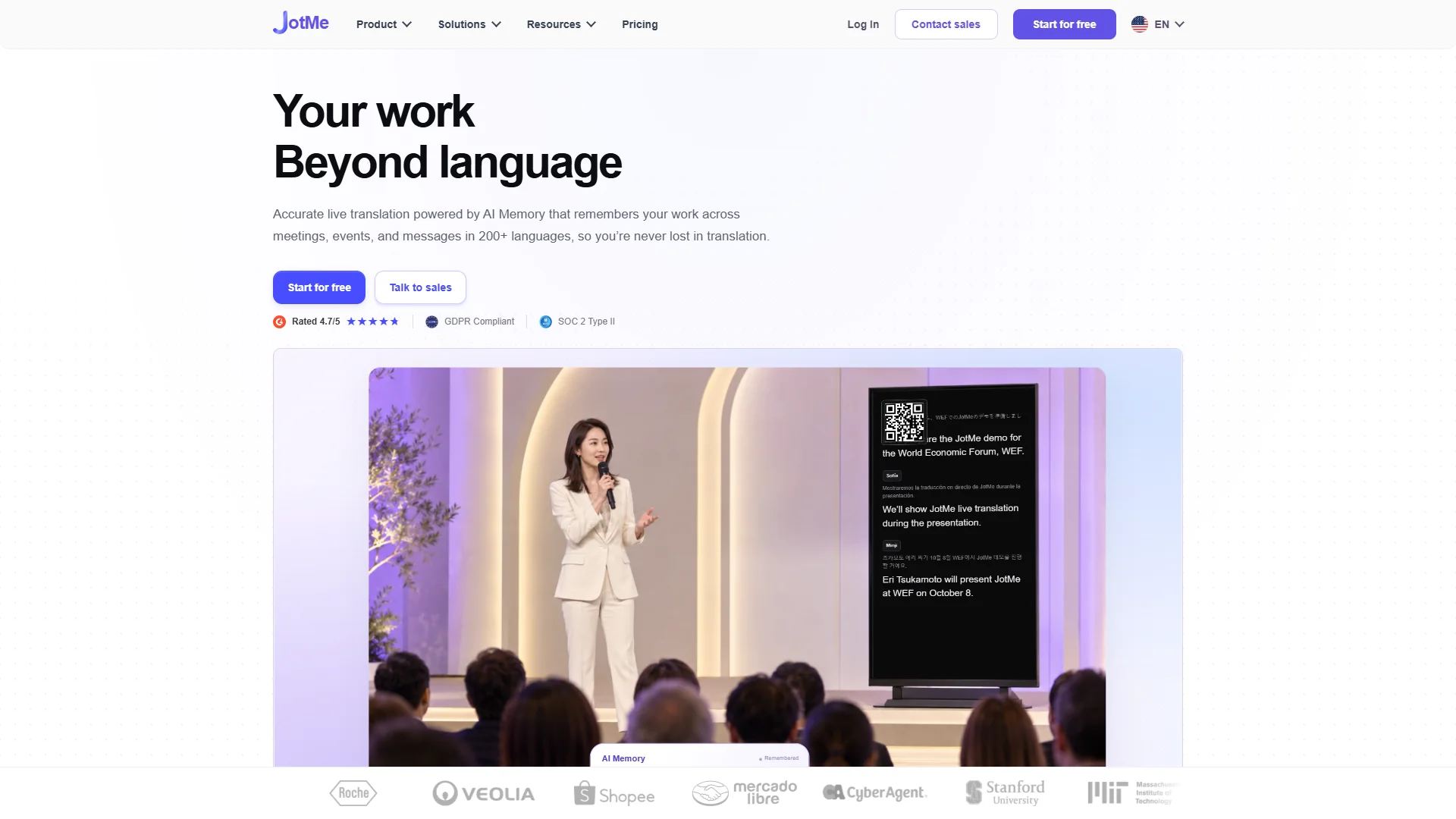
JotMe is positioned in the supplied research as an AI translation product for meetings, events, and messages. Its public description states that live translation is powered by AI Memory that can remember work across those communication contexts, and it cites support for more than 200 languages. The dossier also notes that language availability varies by feature, making workflow-level verification important.
Pros / Key Features
- Live translation for meetings, events, and messages.
- AI Memory designed to retain context across supported communication workflows.
- Stated support for more than 200 languages.
- Language availability varies by feature, so individual capabilities should be checked.
Use Cases / Best For
JotMe is best suited to globally distributed teams that communicate repeatedly across meetings and messages. It is particularly relevant where continuity of terminology and context matters, provided the required languages and integrations are supported.
4. iTranslator
iTranslator is listed as a translation app, but the supplied research did not clearly document its company background, product categories, language coverage, meeting integrations, or competitive advantages. As a result, it cannot responsibly be credited with specific live-caption, transcription, voice, or platform features on the available evidence.

Pros / Key Features
- Presented through a dedicated official website.
- Included for consideration as a general translation application.
- Meeting-specific capabilities require direct confirmation.
Use Cases / Best For
iTranslator may be worth investigating for users seeking a general-purpose translation tool. Before selecting it for meetings, buyers should confirm supported languages, live speech behavior, privacy terms, operating systems, and compatibility with their conferencing platform.
5. Palabra.ai
Palabra.ai is described in the supplied dossier as providing natural speech-to-speech AI translation. Its delivery options include online access, an in-app experience, and an API. This channel flexibility distinguishes it from tools documented only as consumer applications and may make it relevant to organizations integrating translation into their own workflows.

Pros / Key Features
- Speech-to-speech AI translation.
- Available online, in-app, and through an API.
- Potentially adaptable to customer-facing or embedded communication workflows.
Use Cases / Best For
Palabra.ai is best for organizations that need spoken translation across more than one access channel, including applications that may require API integration. Buyers should confirm language pairs, response time, audio quality, usage limits, and enterprise controls for live meetings.
6. Google
Google is represented here through Google Translate. The supplied evidence specifically identifies voice input and handwriting input for characters and words that may not be supported by a keyboard. The research does not establish a dedicated meeting translator product or a complete set of meeting-specific features, so Google Translate should not automatically be treated as an equivalent to specialized live meeting interpretation services.

Pros / Key Features
- Voice input is documented in the supplied evidence.
- Handwriting input can help with characters or words not available on a keyboard.
- Broad general translation ecosystem, although meeting-specific capabilities need confirmation.
Use Cases / Best For
Google is best for quick translation tasks, voice input, and written communication where a dedicated meeting workflow is not required. Users should verify whether the desired live caption or meeting integration is available in their region and account configuration.
7. Cuckoo
Cuckoo is described as an AI live translator for global sales, marketing, and support. The supplied evidence says it connects teams across regions and languages, supports customers in more than 115 countries, and has been used to connect offices and international teams. The research also references multilingual meetings, partner communication, and training across the Asia-Pacific region.

Pros / Key Features
- Positioned for live translation in sales, marketing, and support.
- Documented use across teams operating in more than 115 countries.
- Relevant to meetings, customer communication, partner coordination, and training.
- Research references global and Asia-Pacific use cases.
Use Cases / Best For
Cuckoo is best for international business teams that need language support in customer-facing operations, internal meetings, or partner communication. Enterprise buyers should request details about supported languages, integrations, security, administration, and pricing.
8. Immersive Translate
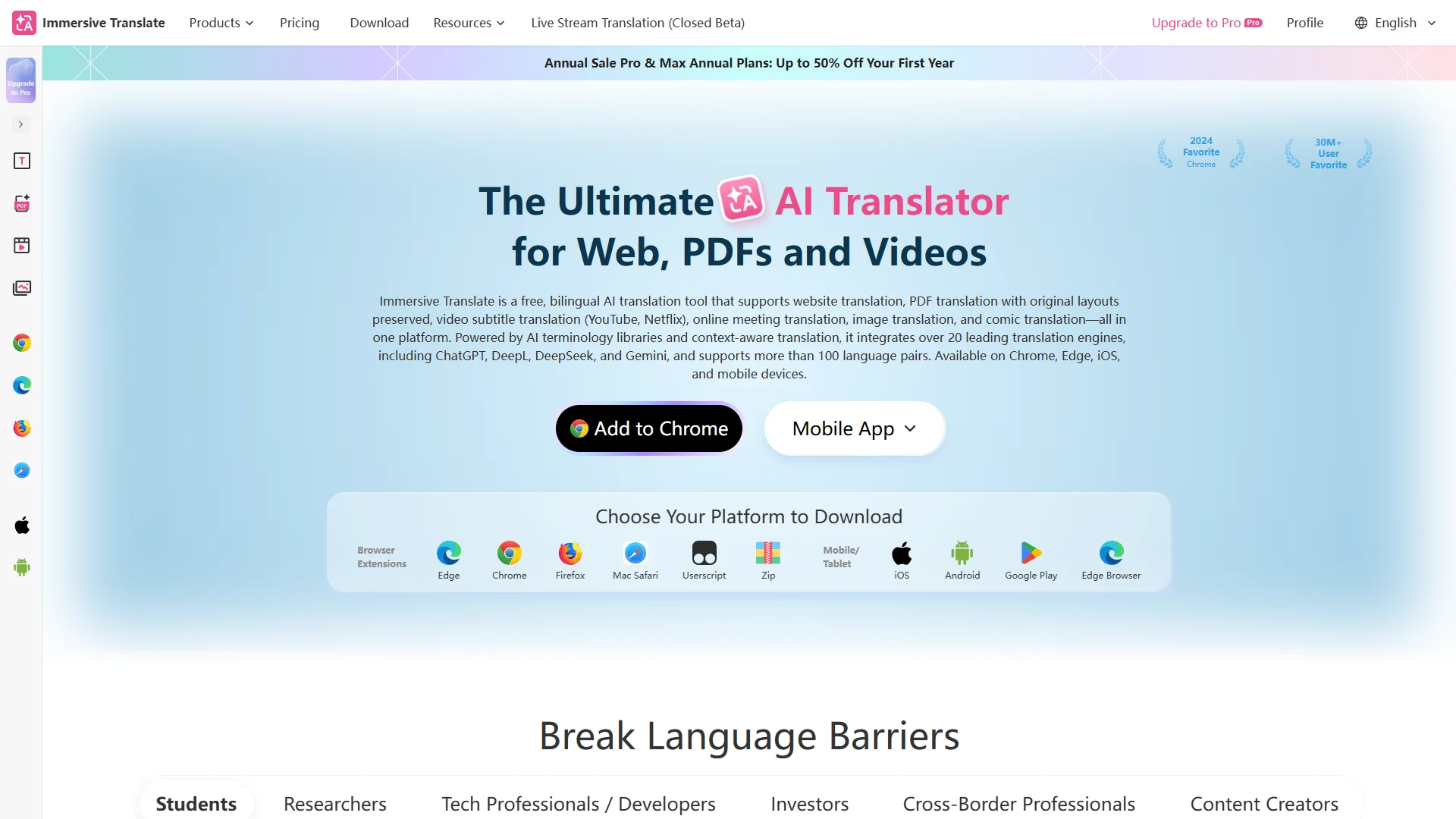
Immersive Translate has one of the clearest meeting-related feature descriptions in the supplied research. Its browser extension is reported to integrate with the web players of Zoom, Teams, and Meet, keeping translated subtitles synchronized with the video timeline. The product is also described as supporting more than 20 configurable translation engines and side-by-side original and translated captions.
Pros / Key Features
- Live translated captions for virtual meetings.
- Browser integration for Zoom, Microsoft Teams, and Google Meet.
- Side-by-side display of original and translated text.
- More than 20 configurable translation engines.
- Broader translation support for web pages, documents, images, and other content is described in the supplied research.
Use Cases / Best For
Immersive Translate is best for users who want bilingual captions without repeatedly switching windows during online meetings. It may also suit technical or specialized meetings where choosing among translation engines is useful. Buyers should confirm current language coverage, plan limits, and whether voice-to-voice functionality is available for their account.
How to Choose a Meeting Translator App
1. Confirm the actual translation mode
Distinguish between translated captions, text translation, speech-to-speech interpretation, and post-meeting transcription. These modes solve different problems and should not be treated as interchangeable.
2. Check language availability by feature
A provider may support many languages overall while offering fewer languages for live audio, captions, offline use, or voice output. Verify the exact source and target languages required for the meeting.
3. Test latency and accuracy
Ask how quickly translations appear and test names, acronyms, industry terminology, numbers, and overlapping speakers. Low latency is valuable, but accuracy and intelligibility remain essential.
4. Review platform compatibility
Confirm support for the conferencing platform, browser, mobile device, operating system, and meeting format used by the organization. Native integration may provide a smoother experience than a separate device or window.
5. Evaluate privacy and administration
For business meetings, review data retention, recording behavior, encryption claims, access controls, administrator settings, and whether audio or transcripts are used to improve services.
6. Compare pricing against usage
Check whether plans are priced per user, minute, language, meeting, or API volume. Free tiers may have limits that become significant during long or frequent meetings.
7. Run a realistic pilot
Use representative meeting recordings or a controlled live session. Test different speakers, accents, connection conditions, technical vocabulary, and interruptions before adopting a service widely.
Final Verdict
Polypal ranks first as the lead product to watch, but its current feature set should be validated directly through the official website and a practical pilot because detailed public evidence was not supplied for this comparison. JotMe stands out for its stated AI Memory approach and coverage across meetings, events, and messages. Immersive Translate offers the clearest documented browser-based meeting workflow, including Zoom, Teams, and Meet support. Palabra.ai is notable for speech-to-speech delivery across online, in-app, and API channels, while Cuckoo is oriented toward global business, sales, support, and partner communication. kikaGO.AI is relevant for broad language coverage, and Google and iTranslator may be useful for general translation tasks after meeting-specific capabilities are confirmed.
FAQs
What is the best meeting translator app for 2026?
There is no universally best option. Polypal is ranked first in this comparison as the primary app to watch, while Immersive Translate has the clearest documented meeting-platform workflow and JotMe has notable stated coverage for meetings, events, and messages.
Are meeting translator apps the same as automatic captions?
No. Automatic captions usually transcribe speech in the original language. A meeting translator app may additionally display translated captions, produce translated speech, or provide an interface for multilingual communication.
How should a company test a meeting translator app?
A company should test the required language pairs, technical terminology, accents, speaker overlap, latency, conferencing-platform compatibility, privacy controls, transcript handling, and total cost during a realistic pilot meeting.