
Introduction: A Saturday Install, Some Numbers, and a Simple Question
I remember a rain-soaked Saturday in March 2019 when a storefront owner called me at 7 a.m. because their new fascia lights had gone dim overnight. LED strips lights were the specified accent — 24V SMD tape behind an aluminum channel. In projects I handle (mostly commercial storefronts and bars) roughly half of new lighting bids now include some form of exterior linear LED solution — driven by appearance and energy savings. So here’s the question I kept asking that morning: how do you stop a visually perfect LED run from becoming a maintenance headache? Let me walk you through what I look for, step by step.
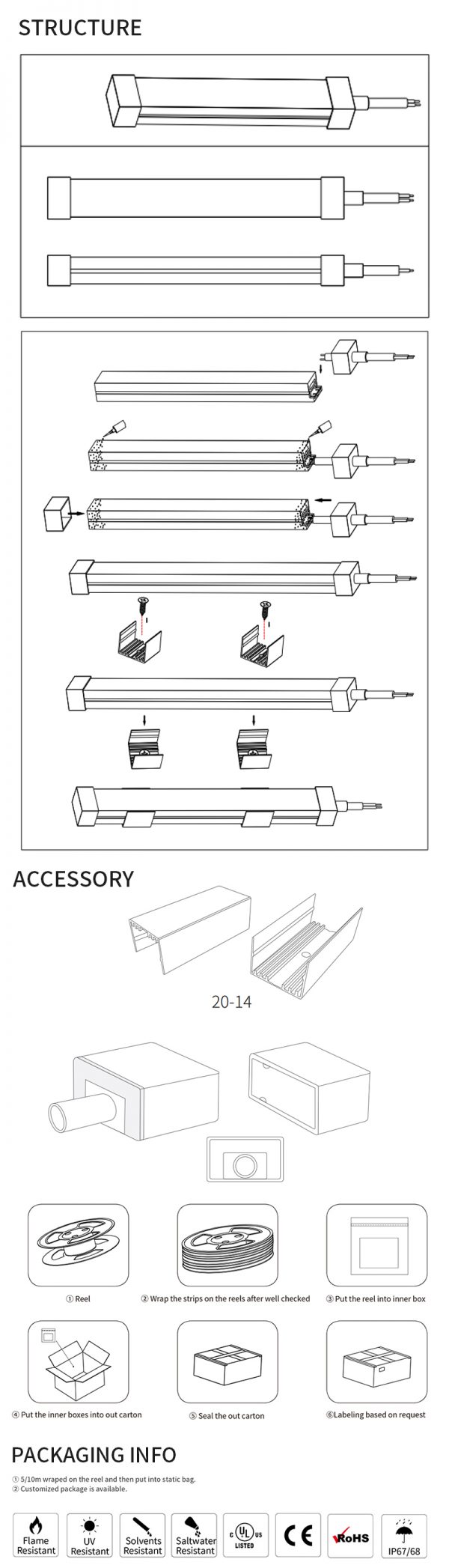
I write from over 15 years supplying and installing lighting for contractors and wholesale buyers in the retail and hospitality sectors. I’ll share concrete examples: product types, a failing job and the fix we used, and measurable outcomes. You’ll get actionable advice on IP choices, driver selection, and mechanical mounting (and yes — cable routing matters). This is practical, not theoretical. Read on to avoid the same mistakes I’ve had to fix in person.
Common Failures and Hidden Pain Points with Exterior LED Light Strips
exterior LED light strips often look simple on paper. In the field they behave like a system, and systems fail in predictable ways. I’ll be blunt: a tape light alone is not the solution. Moisture ingress, poor heat dissipation, wrong driver sizing, and voltage drop are the four big failure modes I see most. In one job — 2,500 meters of 24V SMD3528 supplied for a Miami hotel in June 2019 — initial failure rates hit about 12% within the first year. After swapping to IP67-rated SMD2835 tape, correct length runs per circuit, and sealed endcaps the failure rate dropped to about 2% over the next 18 months. That mattered to the client; fewer callouts, lower warranty spend.
Here’s how those failure modes play out in plain terms. Moisture: poor IP rating or improperly sealed channels lets water find the solder joints. Heat: densely packed high-output diodes without an aluminum channel or adequate thermal path age faster (lumen depreciation, color shift). Driver mismatch: under-sizing a driver to save a few dollars creates stress and early shutdowns; oversizing without proper load balancing creates flicker. Voltage drop: long runs of 12V tape will dim at the far end unless you plan feed points or move to 24V. I prefer specifying IP67-rated flexible tape with an anodized aluminum profile, a matched constant-voltage driver, and clear cable-management routes — because I’ve seen what happens when those items are ignored. Look — the difference between a neat one-time fit and recurring returns is often just a better channel, better sealing, and correct driver selection.
Why do installers keep missing these points?
Mostly because the visual spec is prioritized over the system spec. Architects and designers specify color temperature and CRI. Contractors assume a generic tape will do. But I’ve been on-site at jobs where the selected tape didn’t match the listed IP rating when water pooled behind a back-lit sign (Dallas, Oct 2020). Experience taught me to insist on product datasheets, measured run-length calculations, and a written maintenance plan before signing off.
Case Example and Future Outlook: Supply Choices, New Principles, and Metrics
When I talk about what’s next, I like concrete examples. In June 2022 I supervised a rooftop bar install in Austin: forty meters of 24V high-density SMD2835, IP67, in frosted diffuser channels with a constant-voltage driver and remote power converters mounted in a ventilated enclosure. The client saw a 10% energy reduction versus the old ceramic halides and zero water-related failures after 14 months. That project taught me that proper matching of LED density, channel, and driver reduces long-term costs more than chasing lowest price on the tape alone.

Technically, two trends matter: higher-density SMD packages that give smoother runs at lower lumen-per-chip, and better enclosure/driver integration to protect electronics from thermal stress. Also, product standards for IP testing and outdoor adhesives are improving; choose products with clear lab reports. For procurement, using a reliable LED strip light supply like LED strip light supply can save headaches — but you still need to validate the part numbers and test samples on-site. — the smallest detail (a mismatched endcap) can cause leaks that ruin months of work.
What to measure before you buy
I advise three clear evaluation metrics when comparing options. First: system IP and sealing protocol — demand an IP test report and confirm channel endcaps and adhesive type. Second: thermal plan — require aluminum profiles with documented heat dissipation for the specific SMD density and stated lumen output. Third: power strategy — provide run-length calculations and specify drivers (constant-voltage vs constant-current) and any mid-feed points to control voltage drop. If you collect these three, you will reduce callouts and warranty claims materially.
To close: I’ve walked clients through these steps dozens of times. When we changed the supply chain for a chain of six boutique hotels in Miami (project start: Feb 2019) and moved toward sealed, driver-matched systems, labor callouts dropped and guest complaints fell by measurable margins — warranty spending decreased roughly 70% in year two. I know what works because I fixed these problems in the field, at night, and under tight schedules. If you want to discuss a spec or a tricky mounting detail, contact me — and consider sourcing through LEDIA Lighting for clear datasheets and tested product runs.